
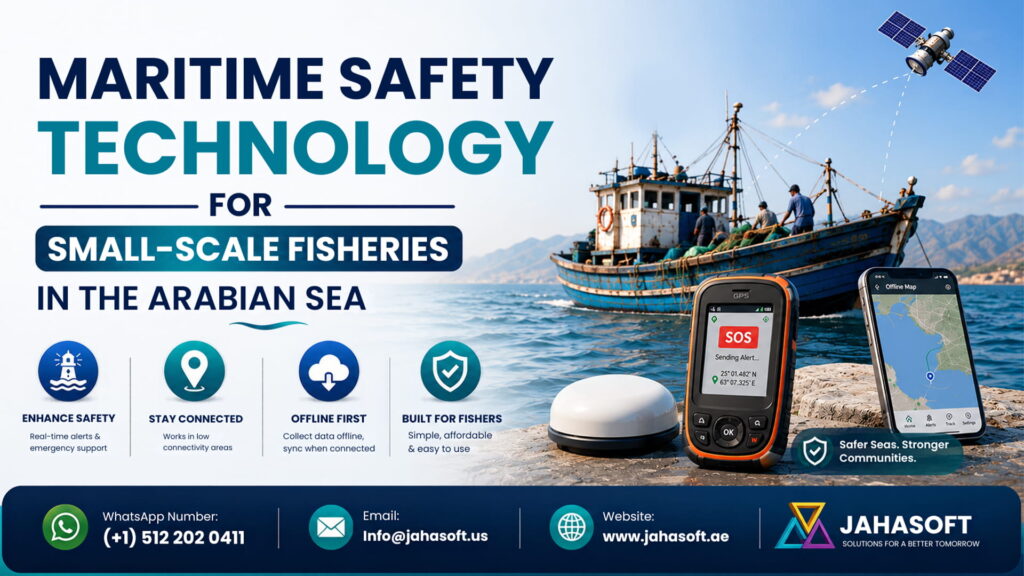
The Arabian Sea supports one of the densest concentrations of small-scale fishing activity anywhere in the world. From the Gulf of Oman down the Makran coast, along the Sindh and Gujarat shorelines, across to Somalia and Yemen, hundreds of thousands of people work from open wooden boats within a day’s reach of shore.
They share a set of conditions that shape everything about how technology has to work for them: sudden weather, dense and busy waters, patchy mobile coverage that disappears offshore, and — for the smallest operators — almost no access to the safety systems that commercial vessels take for granted.
Most maritime safety technology was not built for this. AIS transponders, EPIRBs and satellite communicators are engineered for vessels with power systems, budgets and regulatory obligations. A fisherman working a 20-foot boat with an outboard motor has none of those.
The gap is not a shortage of technology. It is that almost nothing has been designed for the constraints these operators actually work under.
What makes the Arabian Sea a specific problem
Regional fisheries share global small-scale challenges, but several factors here compound them.
Weather that changes fast. The southwest monsoon brings heavy seas across a long season. Cyclone activity in the Arabian Sea has become more frequent and more intense in recent decades, and systems can form and intensify quickly. Boats that left in calm conditions can be caught within hours.
Coverage that ends at the horizon. Mobile signal typically disappears within a few kilometres of shore. Many small-scale operators fish well beyond that. Any safety system that requires mobile data will be offline for the majority of the time it is needed.
Extreme heat and humidity. Screen legibility in direct Gulf and Arabian Sea sun is a real engineering constraint, not a design preference. Devices also run hot, which affects battery life exactly when it matters.
Multiple languages, often multiple dialects. Arabic, Balochi, Urdu, Sindhi, Gujarati, Malayalam, Somali and Persian are all working languages of Arabian Sea fisheries, frequently within the same port. Literacy levels vary widely.
Migrant and cross-border crews. A significant share of crew members work far from home, sometimes without documentation, often without a phone number that reaches family in an emergency.
Busy and contested waters. Shipping lanes, restricted zones around ports and naval facilities, and disputed maritime boundaries all create risk beyond the weather. A fisherman who drifts into the wrong area may face consequences unrelated to the sea.
Why conventional maritime safety systems do not reach these operators
Three barriers keep proven technology out of small-scale hands.
Cost. A satellite communicator with an annual subscription, or a Class B AIS transponder plus installation, is often a substantial share of a small operator’s annual income.
Power and installation. Many small boats have no fixed electrical system beyond starting the motor. Equipment that requires permanent mounting and continuous power is impractical.
Regulatory reach. Safety equipment mandates generally apply to registered commercial vessels. A large proportion of small-scale fishing activity in the region sits partly or wholly outside that framework, so mandates simply do not reach the boats most at risk.
The device almost every fisherman already owns, however, is a mobile phone. Usually an inexpensive Android handset. Often several years old.
That phone is the most realistic safety platform available for this segment — but only if the software is built for how it will actually be used.
Designing for the boat, not the boardroom
We built and shipped a system under exactly these conditions in 2026: Safe Catch, an offline-first safety application for small-scale fishermen on the Makran coast of Balochistan, Pakistan. It was developed for a locally-led NGO under a programme supported by a UK safety foundation, and it is live on the Google Play Store.
The engineering decisions that made it work are transferable across the region.
Nothing may depend on an internet connection
Every function runs from local storage. Training content, safety guidance, emergency systems and the most recent weather forecast all work with the phone in airplane mode. When a connection appears — briefly at the harbour, near a tower on the way out — the app synchronises in the background without the user initiating anything.
The emergency alert must survive a total signal loss
An SOS in Safe Catch triggers four things at once:
- SMS over 2G carrying the fisherman’s name, boat name and GPS coordinates. 2G reaches considerably further offshore than data, and it works where an app cannot load at all.
- A repeating audio alarm loud enough for nearby vessels to hear across open water.
- The camera flash blinking Morse code SOS — three short, three long, three short — which is visible at distance at night.
- A Bluetooth relay that hands the alert to any other boat running the app within range, so the message can hop vessel to vessel until one has coverage.
That last mechanism is the important one. In dense fishing grounds, boats cluster. A vessel with no signal is frequently within a few hundred metres of one that has it, or of one that will shortly move into coverage. Peer relay converts that proximity into a communication path.
Devices must be the ones people already own
Safe Catch was capped at under 25 MB and targets Android 7.0 and above. That constraint eliminated several attractive technical options during development, and it was the right trade. An app that will not install on a five-year-old budget handset protects nobody.
Audio is the interface, not a feature
Every screen carries a speaker button that reads the content aloud. Training is structured as one image, one short sentence, one audio clip. A user who cannot read completes the full course by listening.
The recordings use the specific dialect spoken in the target community rather than a standardised regional variant. Crews notice the difference immediately, and it affects whether they trust the tool.
Broadcast radio still matters
The app displays the local FM emergency frequency, which carries a daily safety bulletin. When the mobile network fails entirely — through outage, congestion or deliberate shutdown — an FM receiver still works. Older technology, but it does not depend on infrastructure that can be switched off.
View Safe Catch on Google Play
Beyond emergencies: the features that get an app opened daily
A safety app that is only opened during an emergency will be forgotten, uninstalled, or sitting on a phone that has since been replaced.
The systems that survive give fishermen a reason to open them every day.
Weather they will actually check. Current conditions, hourly detail, a seven-day forecast, wind speed and a plain-language sea condition assessment — stored on the device so it is readable at sea.
Catch records. A simple log of species, weight and location builds, over time, into a record that supports credit applications, insurance, cooperative membership and traceability claims. In the Gulf states in particular, documented provenance is becoming commercially relevant.
Price information. Landing-site prices delivered by SMS let a fisherman know what a catch is worth before reaching the buyer. This single feature does more for daily engagement than most safety functions.
Peer communication. Boat-to-boat messaging over Bluetooth, beyond its emergency function, reduces the isolation of long trips — which crews consistently rate as valuable.
Equipment checklists. A pre-departure check covering life jackets, first aid supplies, fuel, water and communication devices, with a completion score, builds routine into behaviour that is otherwise inconsistent.
Safety adoption follows daily utility. Build the utility and the safety features are there when they are needed.
Where this fits regional priorities
Several current policy directions across the region point toward exactly this kind of work.
The UN Early Warnings for All initiative aims to ensure every person on earth is covered by an early warning system by 2027, with an explicit focus on reaching populations that current systems miss. Coastal fishing communities without connectivity are precisely that population, and last-mile delivery — getting a warning into the hands of someone at sea — is the pillar where the gap is widest.
Gulf food security strategies have raised the profile of domestic fisheries, and traceability and sustainability certification increasingly depend on data captured at the point of catch. That data has to come from the boat.
Maritime domain awareness efforts across the region benefit when small vessels can be located and contacted, particularly for search and rescue coordination.
Climate adaptation funding for coastal communities is increasing, and early warning access for fishing populations is a well-evidenced, comparatively low-cost intervention.
For an NGO, fisheries authority, cooperative or foundation working in this space, the technical groundwork is done. What remains is adaptation to local languages, local hazards and local emergency contacts.
Adapting a system like this for another coast
The architecture transfers. The content does not, and should not.
What stays the same: offline-first local storage, background synchronisation, SMS-based alerting, peer-to-peer relay, audio-led interface, strict size and OS constraints.
What has to be rebuilt for each deployment:
- Language and dialect, recorded locally with community validation
- Emergency contacts — the correct coastguard, maritime authority, rescue coordination centre and fisheries department numbers, verified as working
- Hazard profile — the weather patterns, seasonal risks and restricted zones specific to that coast
- Weather data sources appropriate to the region
- Community distribution, typically phone-to-phone at landing sites rather than through an app store
Timelines depend on scope and language count. A regional adaptation of an existing architecture is substantially faster than a first build, because the hard engineering problems have already been solved once.
Working with JahaSoft
We build software for environments where the usual assumptions fail — no reliable connectivity, low literacy, inexpensive devices, multiple languages, and users who abandon anything that is difficult. Safe Catch is the clearest example, but the same discipline runs through our work in logistics, retail and field operations.
If you are a fisheries authority, NGO, cooperative, foundation or maritime organisation considering a safety or data system for small-scale operators, we would be glad to discuss it before a specification is written. Scoping conversations at that stage prevent a great deal of expensive rework later.
You can review our full software development services or reach the team through the contact page.
Telephone: (+1) 512 202 0411
Email: [email protected]
It covers tools that help small fishing operators avoid and survive emergencies at sea — weather warnings, distress alerting, position reporting, safety training and communication. For small-scale operators, this increasingly means mobile applications running on inexpensive phones rather than dedicated marine equipment, which is generally too costly and too power-hungry for small open boats.
Through offline-first design. All content and functions are stored on the device and run without a connection. Emergency alerts use 2G SMS, which reaches considerably further offshore than mobile data, and peer-to-peer Bluetooth relay allows an alert to pass from boat to boat until one vessel has coverage. Audio alarms and camera-flash Morse signalling work with no network at all.
Yes, and adaptation is considerably faster than a first build. The underlying architecture transfers directly. What must be rebuilt is the content layer: local language and dialect audio, verified emergency contacts, region-specific hazards and weather sources, and a distribution approach suited to local landing sites.
Early Warnings for All aims to give every person on earth access to an early warning system by 2027, with emphasis on populations current systems fail to reach. Fishing communities working beyond mobile coverage are a clear example of that gap, and last-mile delivery is the pillar where the shortfall is largest. Offline-capable mobile applications with SMS alerting address that pillar directly.